Editorial Review
Author: PurePep Vital Research Editorial Team|Reviewed by: Scientific Compliance Reviewer
Last reviewed: March 2026
What Is Bacteriostatic Water and Why Is It Used for Peptides?
Bacteriostatic water (BAC water) is sterile water that contains 0.9% benzyl alcohol as a preservative.
This seemingly simple formulation serves a critical function in peptide research: it dissolves lyophilized (freeze-dried) peptides into solution while simultaneously inhibiting microbial growth, allowing the reconstituted solution to be used over multiple withdrawal sessions without contamination.
The United States Pharmacopeia (USP) defines bacteriostatic water as "Water for Injection containing 0.9% (v/v) benzyl alcohol," and it is manufactured under strict current Good Manufacturing Practice (cGMP) conditions.
Lyophilized peptides are inherently stable as dry powders, with shelf lives measured in years when stored properly. However, once reconstituted into solution, peptides become susceptible to microbial contamination, hydrolytic degradation, and oxidative damage.
Bacteriostatic water addresses the first of these concerns directly — the benzyl alcohol preservative maintains a bacteriostatic environment that prevents bacterial colonization even after the vial septum has been punctured multiple times.
This is why bac water for peptides has become the default reconstitution solvent in research laboratories worldwide.
Understanding the role of bacteriostatic water requires understanding the broader context of peptide handling. Peptides are chains of amino acids linked by peptide bonds, and their biological activity depends on maintaining precise three-dimensional structures.
Improper reconstitution — using the wrong solvent, incorrect volumes, or non-sterile technique — can denature the peptide, introduce contaminants, or produce inaccurate concentrations that compromise research outcomes. For foundational peptide biology, see our comprehensive peptide guide.
Bacteriostatic Water vs. Sterile Water vs. Acetic Acid: Which Solvent to Use
Three reconstitution solvents are commonly used in peptide research: bacteriostatic water, sterile water for injection, and dilute acetic acid. Each has distinct properties, advantages, and appropriate use cases that researchers must understand to select the correct solvent for each peptide.
Bacteriostatic Water (0.9% Benzyl Alcohol)
BAC water is the default choice for most peptide reconstitutions. The benzyl alcohol preservative allows the reconstituted solution to remain viable for up to 28 days after initial puncture when stored at 2-8°C.
This multi-use capability makes it the most practical option for research protocols requiring repeated withdrawals from the same vial. The pH of bacteriostatic water typically ranges from 4.5 to 7.0, which is compatible with the vast majority of research peptides.
One important consideration: benzyl alcohol can interact with certain peptides at the molecular level, potentially affecting stability in rare cases.
Sterile Water for Injection (SWFI)
Sterile water contains no preservatives whatsoever — it is simply purified water that has been sterilized and packaged under aseptic conditions.
This makes it the appropriate choice when benzyl alcohol sensitivity is a concern or when protocols specifically require preservative-free solutions.
The critical limitation of sterile water is that it must be used within 24 hours of opening and should ideally be used immediately, as it provides no protection against microbial contamination once the vial is accessed.
In research settings where a single peptide aliquot will be used in its entirety during one session, sterile water for peptides is perfectly adequate.
Acetic Acid Solutions (0.1-1.0%)
Dilute acetic acid is required for peptides that are poorly soluble at neutral pH, particularly those with high proportions of hydrophobic amino acids or those carrying a net positive charge at physiological pH.
Peptides such as amyloid-beta fragments, certain growth hormone-releasing peptides, and some antimicrobial peptides dissolve more readily in mildly acidic solutions. Acetic acid for peptides is typically prepared at concentrations of 0.1% (approximately pH 3.0) to 1.0% (approximately pH 2.4).
Researchers should note that the acidic environment accelerates hydrolysis of certain peptide bonds — particularly Asp-Pro bonds — so acetic acid reconstitutions should be used relatively quickly after preparation.
A practical decision framework: use bacteriostatic water as the default unless the peptide manufacturer specifies otherwise, use sterile water when the protocol requires preservative-free solution or single-use preparation, and use acetic acid only when the specific peptide requires acidic conditions for solubility.
How the Benzyl Alcohol Preservative Works
The 0.9% benzyl alcohol in bacteriostatic water is not an arbitrary additive — it is a carefully calibrated antimicrobial agent that disrupts bacterial cell membranes without denaturing most peptides. Understanding this mechanism helps researchers appreciate both the benefits and limitations of BAC water as a reconstitution solvent.
Benzyl alcohol (C₆H₅CH₂OH) is an aromatic alcohol that exerts its bacteriostatic effect primarily through disruption of bacterial membrane integrity. It intercalates into the lipid bilayer of bacterial cell membranes, increasing membrane fluidity and permeability.
This causes leakage of intracellular contents and disruption of membrane-bound enzyme systems, particularly the electron transport chain components essential for bacterial energy production.
At 0.9% concentration, benzyl alcohol is sufficient to prevent bacterial growth (bacteriostatic) but does not necessarily kill all existing organisms (bactericidal). This distinction matters: bacteriostatic water inhibits contamination but does not sterilize already-contaminated solutions.
A study published in the Journal of Pharmaceutical Sciences (2008) evaluated the antimicrobial effectiveness of benzyl alcohol at concentrations from 0.5% to 2.0% against common environmental contaminants including Staphylococcus aureus, Pseudomonas aeruginosa, Escherichia coli, and Candida albicans.
At the standard 0.9% concentration, benzyl alcohol demonstrated effective growth inhibition against all tested organisms for the 28-day evaluation period mandated by USP <71> antimicrobial effectiveness testing.
The preservative also exhibits mild solvent properties that can enhance peptide solubility in some cases.
However, benzyl alcohol can interact with certain formulation components — for instance, it is adsorbed by some rubber closures and certain plastic materials, which can reduce effective concentration over time.
This is why glass vials with butyl rubber stoppers are the preferred container system for bacteriostatic water in peptide research applications.
Free Peptide Calculator
Calculate precise reconstitution volumes and dosages with our peptide calculator tool.
Step-by-Step Peptide Reconstitution Technique
Proper reconstitution technique directly impacts the integrity and concentration accuracy of peptide solutions. The following protocol represents standard laboratory practice for reconstituting lyophilized peptides with bacteriostatic water for peptide reconstitution:
Step 1: Preparation and Equipment
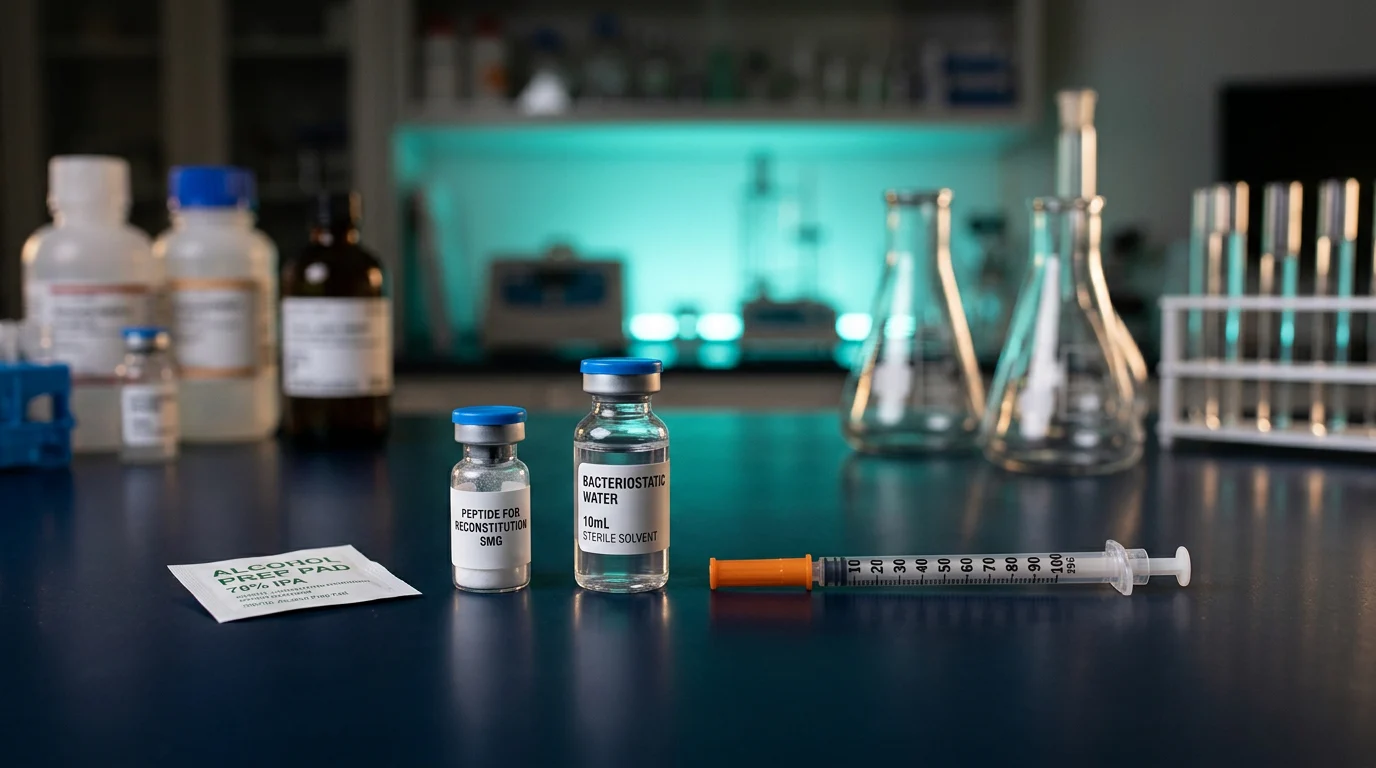
Gather the following materials: lyophilized peptide vial, bacteriostatic water vial (USP grade), appropriately sized syringes (insulin syringes for volumes under 1 mL, standard syringes for larger volumes), alcohol swabs (70% isopropyl alcohol), and a clean work surface.
Allow both the peptide and BAC water to reach room temperature — cold solutions can impair dissolution and cause condensation that introduces moisture.
Step 2: Volume Calculation
Determine the appropriate reconstitution volume based on the desired concentration. For example, a 5 mg vial reconstituted with 2.5 mL of bacteriostatic water produces a 2 mg/mL (2,000 mcg/mL) solution.
Use our peptide reconstitution calculator to determine precise volumes for the target concentration and withdrawal doses. The general principle: larger reconstitution volumes produce more dilute solutions with smaller per-unit withdrawal volumes, improving measurement accuracy for low-dose protocols.
Step 3: Reconstitution Process
Swab the tops of both the peptide vial and BAC water vial with alcohol and allow to dry (approximately 30 seconds). Draw the calculated volume of bacteriostatic water into the syringe.
Insert the needle through the peptide vial stopper at a slight angle and direct the water stream against the glass wall of the vial — never spray directly onto the lyophilized powder cake, as the mechanical force can damage peptide structure.
Allow the water to flow gently down the vial wall and contact the powder gradually.
Step 4: Dissolution
After adding the water, do not shake the vial vigorously. Instead, gently swirl the vial in a circular motion or roll it between the palms. Most peptides will dissolve within 1-3 minutes with gentle agitation.
If the peptide does not dissolve within 5 minutes, allow it to sit at room temperature for up to 30 minutes — some peptides require extended hydration time.
Never sonicate or vortex peptide solutions, as these mechanical forces can fragment or denature the molecules.
Step 5: Visual Inspection
The reconstituted solution should be clear and colorless. Cloudiness, particulate matter, or color changes indicate potential degradation, contamination, or incomplete dissolution.
If the solution appears cloudy after 30 minutes at room temperature, the peptide may require a different solvent (such as dilute acetic acid) or may have degraded during storage. For detailed administration guidance, refer to our peptide therapy guide.
Get Peptide Research Updates
New research, product launches, and exclusive offers. No spam.
Storage Requirements and Shelf Life
Storage conditions are the single most important factor determining how long a reconstituted peptide solution remains viable. Both the bacteriostatic water itself and the reconstituted peptide solution have specific storage requirements that researchers must observe rigorously.
Unreconstituted BAC Water: Unopened bacteriostatic water vials should be stored at controlled room temperature (20-25°C) and protected from light.
The shelf life of unopened BAC water is typically 2-3 years from the date of manufacture, as indicated on the product label.
Once opened (punctured), the vial should be used within 28 days — the period for which the benzyl alcohol preservative has been validated to maintain antimicrobial effectiveness under USP testing standards.
Reconstituted Peptide Solutions: After reconstitution, peptide solutions must be stored at 2-8°C (standard refrigerator temperature) regardless of which solvent was used. This temperature range slows both chemical degradation (hydrolysis, oxidation, deamidation) and any potential microbial growth.
Most reconstituted peptides maintain acceptable stability for 21-28 days when stored in this range and prepared with bacteriostatic water. Some peptides — particularly those prone to aggregation or oxidation — may have shorter effective shelf lives even when properly stored.
Freezing Reconstituted Peptides: Freezing reconstituted peptide solutions is generally not recommended unless the specific peptide has been validated for freeze-thaw stability. The ice crystal formation during freezing can mechanically disrupt peptide structure, and repeated freeze-thaw cycles are particularly damaging.
If freezing is necessary, aliquoting the solution into single-use volumes before freezing minimizes freeze-thaw damage. Some researchers add cryoprotectants (such as trehalose or mannitol) to improve freeze-thaw recovery, but these additives may interfere with downstream research applications.
Light Protection: Many peptides are photosensitive — UV and visible light can trigger oxidation of tryptophan, tyrosine, and methionine residues. Reconstituted peptide vials should be wrapped in aluminum foil or stored in amber vials to prevent photodegradation. Even indirect fluorescent lighting during a typical laboratory workday can measurably degrade sensitive peptides over a 28-day storage period.
Important Disclaimer
All products and information on this page are intended strictly for laboratory and scientific research use only. Not for human consumption. These statements have not been evaluated by the FDA.
Volume Calculations and Concentration Management
Accurate reconstitution volume calculations are essential for producing peptide solutions at the intended concentration. Errors in this step propagate through every subsequent measurement, potentially compromising entire research protocols. The mathematics are straightforward but require careful attention to units.
The fundamental equation is: Concentration (mg/mL) = Peptide Mass (mg) ÷ Reconstitution Volume (mL). For example, a 10 mg peptide vial reconstituted with 2 mL of bacteriostatic water yields a 5 mg/mL solution. Each 0.1 mL (100 units on an insulin syringe) withdrawal then contains 500 mcg of peptide.
Practical considerations that affect volume selection include:
- Syringe accuracy: Standard insulin syringes (U-100, 1 mL capacity) are marked in 2-unit (0.02 mL) increments. The minimum accurately measurable volume is approximately 0.05 mL (5 units). Reconstitution volumes should be chosen so that the target withdrawal dose corresponds to at least 5-10 units on the syringe to minimize measurement error.
- Dead volume: Every syringe retains a small volume of solution in the hub and needle after injection (typically 0.03-0.07 mL for insulin syringes). This "dead volume" represents lost peptide that should be accounted for in total yield calculations, especially when working with expensive or limited-quantity peptides.
- Overfill consideration: Many peptide vials contain a slight overfill (5-10% above the labeled amount) to account for withdrawal losses. While this should not be relied upon for precise dosing, it does mean that actual concentrations may be slightly higher than calculated from labeled mass alone.
Use our peptide reconstitution calculator to automate these calculations. Enter the peptide mass, desired concentration, and the calculator generates the required bacteriostatic water volume and per-unit withdrawal doses automatically.
Contamination Prevention and Aseptic Technique
Even with the antimicrobial protection of benzyl alcohol, proper aseptic technique during reconstitution and withdrawal is essential for maintaining solution integrity throughout its use period. Contamination can introduce particulate matter, endotoxins, and microbial byproducts that compromise both peptide stability and research validity.
Aseptic Work Environment: Reconstitution should be performed on a clean, disinfected surface. While a laminar flow hood is ideal, a recently wiped surface using 70% isopropanol is adequate for most research applications. Avoid reconstituting peptides in areas with high foot traffic, open windows, or active HVAC airflow that could introduce airborne contaminants.
Alcohol Swabbing Protocol: Every vial stopper must be swabbed with 70% isopropyl alcohol before needle insertion — every single time, including subsequent withdrawals from previously accessed vials. Allow the alcohol to dry completely (approximately 30 seconds) before puncturing.
Wet alcohol on the stopper can be carried into the vial by the needle, potentially affecting peptide stability or introducing contaminants dissolved in the alcohol solution.
Single-Use Syringe Policy: Never reuse syringes or needles for peptide withdrawal. Each withdrawal should use a fresh, individually packaged sterile syringe and needle. The cost of a new syringe is negligible compared to the cost of contaminated peptide solution or compromised research data.
Needle Gauge Selection: For withdrawing from and injecting into vials, 27-30 gauge needles are standard.
Smaller gauge needles (higher numbers) create smaller puncture holes in vial stoppers, reducing the cumulative damage from multiple withdrawals and minimizing the risk of stopper coring — where small pieces of rubber are punched into the solution by the needle.
Insert needles at a 45-degree angle with the bevel facing up to further reduce coring risk.
Signs of Contamination: Discard any reconstituted peptide solution that shows cloudiness, color change, visible particles, unusual odor, or film formation on the solution surface. These signs indicate microbial contamination, chemical degradation, or both. When in doubt, discard — the cost of replacing peptide material is always less than the cost of compromised research outcomes.
Where to Source Quality Bacteriostatic Water
The quality of bacteriostatic water directly affects peptide reconstitution outcomes, yet not all commercially available BAC water meets the standards required for research use. Understanding what differentiates high-quality bacteriostatic water from substandard products helps researchers make informed purchasing decisions.
USP Grade Certification: Bacteriostatic water for peptide reconstitution should be manufactured according to United States Pharmacopeia (USP) standards, specifically USP <797> for sterile compounding and USP <71> for sterility testing.
USP-grade BAC water has been validated for sterility, endotoxin levels (below 0.5 EU/mL), benzyl alcohol concentration accuracy (0.9% ± 0.1%), and pH range.
Products lacking USP certification may contain inconsistent preservative concentrations, elevated endotoxin levels, or microbial contamination that undermines their intended purpose.
Packaging Considerations: Quality bacteriostatic water is packaged in Type I borosilicate glass vials with 20mm butyl rubber closures sealed with aluminum flip-off caps. Glass is inert and does not leach chemicals into the solution.
Some lower-cost products are packaged in plastic containers that may leach plasticizers (particularly phthalates) into the solution over time — these should be avoided for peptide reconstitution applications.
Volume Options: Bacteriostatic water is commonly available in 10 mL, 20 mL, and 30 mL vials; some suppliers also list smaller fills (for example 3 mL) suited to low-volume labs that want to limit waste between punctures.
For researchers working with multiple peptides, 30 mL vials offer better value but must be used within 28 days of first puncture. Researchers working with only one or two peptides may prefer smaller vials to minimize waste.
PurePep does not bundle or ship reconstitution supplies with peptides—compare third-party shop listings and read each retailer’s product details.
Common Reconstitution Mistakes and How to Avoid Them
Even experienced researchers occasionally make reconstitution errors that compromise peptide integrity. The following are the most commonly observed mistakes in peptide reconstitution protocols, along with guidance for prevention:
Spraying Water Directly onto the Peptide Cake: High-pressure injection of reconstitution solvent directly onto the lyophilized powder creates localized mechanical stress that can fragment or denature sensitive peptides. The correct technique is to direct the water stream against the vial wall, allowing it to flow gently down to the powder.
Using the Wrong Solvent: Reconstituting a peptide that requires acetic acid with bacteriostatic water (or vice versa) can result in incomplete dissolution, precipitation, or accelerated degradation. Always consult the manufacturer documentation or Certificate of Analysis for the recommended reconstitution solvent before proceeding.
Shaking or Vortexing the Vial: Vigorous agitation introduces air-liquid interfaces that promote peptide aggregation and denaturation — the same phenomenon that causes egg whites to become opaque when beaten. Gentle swirling is sufficient for dissolution and preserves peptide structure.
Incorrect Volume Calculations: Using too little solvent produces an overly concentrated solution that may exceed solubility limits, causing precipitation. Using too much solvent produces a dilute solution requiring large withdrawal volumes that reduce measurement precision. Double-check calculations before adding solvent — it is far easier to add more than to remove excess.
Room Temperature Storage After Reconstitution: Leaving reconstituted peptide solutions at room temperature — even for a few hours — dramatically accelerates degradation. Hydrolysis rates approximately double for every 10°C increase in temperature. Reconstituted solutions should be returned to 2-8°C refrigeration immediately after each withdrawal session.
Reusing Needles Between Different Peptide Vials: Cross-contamination between peptide vials can introduce incompatible compounds, alter concentrations, and invalidate research results. Always use a fresh needle for each vial access. For complete best practices, see our peptide injections guide.
Important Disclaimer — For Research Use Only
The information provided is for educational and research purposes only. All peptides discussed or linked on this site are intended strictly for laboratory and scientific research use only (RUO) and are not for human consumption, injection, ingestion, or any therapeutic application. These products have not been evaluated or approved by the FDA or any regulatory body and are not intended to diagnose, treat, cure, or prevent any disease or condition. Reliance on this content is at your own risk. Consult qualified professionals for any health-related decisions. PurePep Vital disclaims all liability for misuse. Products are offered by third-party retailers for research use only.
PurePep Vital is an editorial publisher, vendor comparison resource, and affiliate deal tracker. We do not manufacture, compound, sell, ship, test, prescribe, or handle peptide products. Purchases are completed directly through third-party retailers. PurePep Vital is not a compounding pharmacy or chemical compounding facility as defined under 503A of the Federal Food, Drug, and Cosmetic Act. PurePep Vital is not an outsourcing facility as defined under 503B of the Federal Food, Drug, and Cosmetic Act.
Disclosure: This page contains affiliate links. We may earn from qualifying purchases. See our full disclosure.
Need deals after the research?
Use the deals hub to compare current offers, partner codes, and research news. We recommend retailers that provide quality signals when available.
Explore Our Guides
Related Articles
Peptide Injections: Complete Guide for Researchers
Proper injection technique is fundamental to peptide research accuracy. This guide covers everything from equipment selection to sterile procedure for consistent, reliable results.
How to Reconstitute Peptides: Step-by-Step Guide
Proper reconstitution is critical for peptide efficacy and safety. Here is a complete step-by-step guide with calculation examples.
Research Peptide Storage: Lyophilized Powder and After Reconstitution
Lyophilized peptide storage, fridge rules, and how long powder lasts—research-focused checklist without dosing advice.
Peptide Dosing Chart: Complete Reference Guide
Accurate peptide dosing is fundamental to research outcomes. This comprehensive chart covers dosing protocols for the most commonly studied peptides based on published research data.
Frequently Asked Questions
Bacteriostatic water contains 0.9% benzyl alcohol as an antimicrobial preservative, allowing multi-use access over 28 days when refrigerated. Sterile water for injection contains no preservatives and must be used within 24 hours of opening. For research protocols requiring multiple withdrawals over days or weeks, bacteriostatic water is the standard choice. Sterile water is appropriate only when the entire reconstituted volume will be used in a single session or when preservative-free solution is specifically required.