Editorial Review
Author: Dr. Elena Vasquez, Ph.D.(Ph.D. Biochemistry · Lead Science Editor)|Reviewed by: Scientific Compliance Reviewer
Last reviewed: June 2026
Why these two peptides are studied together
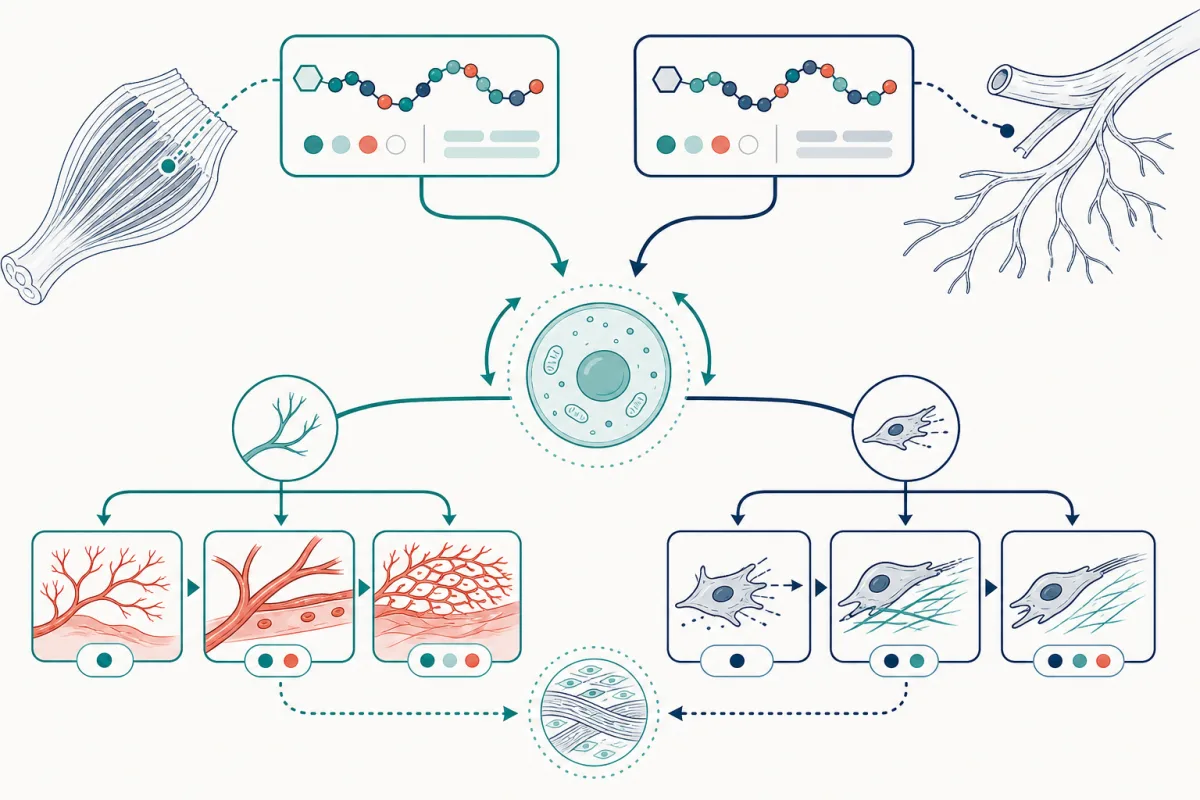
Search interest in the "BPC-157 and TB-500 stack" reflects a genuine pattern in the recovery literature: these are the two most frequently co-investigated peptides in connective-tissue and soft-tissue repair models. The pairing is not arbitrary. Each compound acts on a distinct, non-overlapping arm of the repair cascade, which is precisely why researchers model them together rather than as substitutes.
BPC-157 is a synthetic pentadecapeptide derived from a protective protein found in gastric juice. TB-500 is the synthetic, research-grade form of the active fragment of thymosin beta-4, a regulatory protein expressed in nearly every mammalian cell type.
One is studied primarily for its effects on local blood-vessel formation and growth-factor expression; the other for its role in cellular migration and structural remodeling. In repair biology, those processes are sequential and interdependent.
It is worth being precise about why the pairing recurs.
Repair is not a single event but a staged process — inflammation, new vessel formation, cell recruitment, matrix deposition, and remodeling — and no single signaling molecule governs all of those stages.
When two compounds map onto different stages, modeling them together is a more faithful representation of the biology than studying either in isolation. That is the structural argument behind the stack, and it holds independently of any specific effect-size claim.
This article frames what the preclinical record supports, where the evidence is thin, and how laboratories assess documentation before sourcing either compound. It is RUO education, not dosing guidance or medical advice. For foundational context, see the BPC-157 compound profile and the TB-500 research guide.
BPC-157: angiogenesis and growth-factor signaling
The published BPC-157 literature concentrates on three observations that recur across rodent injury models. First is angiogenesis — the formation of new capillaries into damaged tissue. Several studies attribute this in part to upregulation of vascular endothelial growth factor receptor 2 (VEGFR2) and downstream nitric oxide signaling, which together improve perfusion of the repair site.
Second is modulation of the growth-factor environment. BPC-157 has been associated in animal tendon and ligament work with increased expression of growth-hormone receptor and with effects on the FAK-paxillin pathway, which governs how fibroblasts adhere and organize during healing.
Third is a consistently favorable preclinical tolerability profile: researchers have repeatedly noted the difficulty of establishing a toxic dose in animal studies, a point covered in our peptide safety review.
Two caveats matter for honest interpretation. Nearly all of this evidence is preclinical — rodent and in vitro — and human controlled-trial data remains limited. And the magnitude of any effect in published work depends heavily on the model, route, and the quality of the peptide used. Uncharacterized material undermines reproducibility before mechanism is ever in question.
TB-500: cell migration and structural remodeling
TB-500 occupies a different niche in the repair cascade. The thymosin beta-4 fragment it represents is best characterized for its interaction with G-actin, the monomeric building block of the cytoskeleton. By sequestering and regulating actin availability, the parent protein influences how cells extend, migrate, and reorganize — the mechanical groundwork of wound closure and tissue remodeling.
In experimental models, thymosin beta-4 has been studied for promotion of cell migration, modulation of inflammation, and effects on endothelial and epithelial cell behavior.
Unlike BPC-157, which is often framed around local vascular and growth-factor effects, TB-500 research emphasizes systemic distribution and the recruitment of repair-competent cells to sites of injury.
Phase II clinical work on thymosin beta-4 itself has been conducted for indications such as dry-eye disease and dermal wound healing, giving this mechanism a somewhat deeper clinical footprint than many research peptides.
The research-grade distinction is important. "TB-500" as sold for laboratory use is not a finished, approved drug; it is a research material whose identity and purity must be confirmed against a certificate of analysis before any conclusions are drawn from experiments that use it.
Free Peptide Calculator
Calculate precise reconstitution volumes and dosages with our peptide calculator tool.
The complementary-pathway rationale
The reason the two appear together so often is mechanistic complementarity rather than additive potency.
A simplified way to frame the repair sequence studied in the literature: damaged tissue first needs perfusion and growth-factor signaling to create a permissive environment, then it needs cells to migrate in and rebuild structure.
BPC-157 research maps most cleanly onto the first phase; TB-500 research onto the second.
Investigators modeling combination protocols hypothesize that addressing both arms simultaneously may better reflect the integrated nature of healing than isolating a single pathway. That is a reasonable experimental rationale — but it remains a hypothesis.
There is, as of 2026, little rigorous controlled data directly comparing the combination against either compound alone in matched models. Claims of defined "synergy" outrun the published evidence.
For laboratories designing comparative work, this gap is the opportunity: clean, documented material and controlled endpoints are exactly what the field lacks. Our overview of research peptide stacks discusses how combination studies are structured, and the tendon-repair research roundup covers adjacent compounds.
Get Peptide Research Updates
New research, product launches, and exclusive offers. No spam.
Documentation: what to verify before sourcing either compound
Because both peptides are sold strictly for research use, documentation quality is the single most controllable variable in any study that relies on them. Before procurement, laboratories typically confirm the following on a batch-specific COA:
- Identity confirmed by mass spectrometry, with the observed mass matching the theoretical mass of the sequence.
- Purity by HPLC, generally ≥98% for research material, with the chromatogram (not just a headline number) available for review.
- Batch number on the COA that matches the vial label — a mismatch is a deviation, not a formality.
- Net peptide content and counterion form (acetate vs trifluoroacetate), which affect how much active material is actually present.
These checks matter more for a combination study than for a single-compound one, because two uncharacterized inputs compound uncertainty. Proper handling after receipt is equally important; see the peptide storage guide for cold-chain and reconstitution norms, and our BPC-157 reconstitution storage notes for compound-specific stability context.
Important Disclaimer
All products and information on this page are intended strictly for laboratory and scientific research use only. Not for human consumption. These statements have not been evaluated by the FDA.
Sourcing the BPC-157 + TB-500 pairing
PurePep Vital does not sell, ship, or test peptides. We compare vendor documentation signals so research laboratories can evaluate offers side by side. For this pairing, both compounds are stocked by multiple tracked vendors, which makes price-per-milligram and COA transparency directly comparable.
Current research listings can be compared on the BPC-157 offers page and the TB-500 offers page, with live pricing and partner codes aggregated on the deals hub.
Among tracked vendors, Live Alpha Labs is our top-rated partner for documentation transparency and credit-card checkout; PurePep readers can use code SOL for 10% off eligible research orders.
BluGen and Halo are compared alongside it so the choice stays evidence-based rather than single-vendor.
For volume and concentration math when planning reconstitution, the free peptide calculator handles the arithmetic; it does not provide dosing recommendations, which fall outside RUO scope.
Formats and routes studied in the literature
A frequent source of confusion is that both peptides appear in multiple physical formats, and the format changes what a study is actually measuring. Lyophilized powder for reconstitution is the standard research presentation, but BPC-157 in particular also appears as oral capsules and nasal sprays in vendor catalogs, each with very different assumptions baked in.
The distinction matters because the published BPC-157 literature is dominated by parenteral and, in gastrointestinal models, oral administration in animals — and bioavailability differs substantially across routes.
A nasal or capsule format is not interchangeable with the injectable material used in most cited studies, and conclusions drawn from one route do not automatically transfer to another.
Researchers designing protocols should match the format to the route used in the literature they are referencing rather than assuming equivalence.
TB-500 is studied almost exclusively as reconstituted material, and its emphasis on systemic distribution makes route and stability especially relevant.
For both compounds, the practical implication is the same: the format on the label is a study variable, not a detail.
Compare available formats on the BPC-157 offers page, and review reconstitution mechanics in the reconstitution guide before planning experiments. The peptide calculator supports the volume math.
Common misconceptions worth correcting
Several claims circulate about this pairing that the evidence does not support, and correcting them is part of responsible research framing.
- "The stack is proven synergistic." The mechanisms are complementary; controlled data isolating combination effects against single compounds remains limited. Complementary is not the same as proven synergistic.
- "More is better." Dose-response in repair models is not linear, and higher input does not reliably translate to better endpoints. This is a research observation, not a dosing recommendation.
- "Research material equals clinical-grade." RUO peptides are not manufactured to the standards of approved drugs. A favorable preclinical record does not make a research vial a therapy.
- "COA numbers are interchangeable." A headline purity figure without the underlying chromatogram and a matching batch number is incomplete documentation, not verification.
Holding these distinctions keeps interpretation honest and keeps the work inside research-use boundaries. For the regulatory backdrop on why this framing matters in 2026, see the FDA reclassification overview.
Honest summary for research planning
The BPC-157 + TB-500 stack is popular in recovery research for a defensible reason: the two compounds target complementary phases of tissue repair rather than the same one. BPC-157 research clusters around angiogenesis and growth-factor signaling; TB-500 research around cell migration and structural remodeling. Modeled together, they approximate the integrated nature of healing better than either alone.
What the evidence supports today:
- Both have substantial preclinical repair-model literature and favorable animal tolerability records.
- Their mechanisms are genuinely complementary, which justifies co-investigation.
- Rigorous controlled data on the combination specifically remains limited — a known gap, not a settled result.
- Purity and documentation dominate reproducibility; uncharacterized material invalidates conclusions regardless of mechanism.
Treat marketing language about guaranteed synergy with skepticism, anchor protocols to COA-verified material, and keep all work within research-use boundaries. For the broader recovery context, continue with the muscle-growth research guide and the TB-500 compound profile.
Important Disclaimer — For Research Use Only
The information provided is for educational and research purposes only. All peptides discussed or linked on this site are intended strictly for laboratory and scientific research use only (RUO) and are not for human consumption, injection, ingestion, or any therapeutic application. These products have not been evaluated or approved by the FDA or any regulatory body and are not intended to diagnose, treat, cure, or prevent any disease or condition. Reliance on this content is at your own risk. Consult qualified professionals for any health-related decisions. PurePep Vital disclaims all liability for misuse. Products are offered by third-party retailers for research use only.
PurePep Vital is an editorial publisher, vendor comparison resource, and affiliate deal tracker. We do not manufacture, compound, sell, ship, test, prescribe, or handle peptide products. Purchases are completed directly through third-party retailers. PurePep Vital is not a compounding pharmacy or chemical compounding facility as defined under 503A of the Federal Food, Drug, and Cosmetic Act. PurePep Vital is not an outsourcing facility as defined under 503B of the Federal Food, Drug, and Cosmetic Act.
Disclosure: This page contains affiliate links. We may earn from qualifying purchases. See our full disclosure.
Need deals after the research?
Use the deals hub to compare current offers, partner codes, and research news. We recommend retailers that provide quality signals when available.
Explore Our Guides
Related Articles

BPC-157 Peptide: The Complete Healing Research Guide
BPC-157 is a pentadecapeptide derived from human gastric juice with extraordinary tissue-healing properties. Here is what decades of research reveal about its mechanisms, benefits, and applications.
TB-500 Peptide: Tissue Repair and Thymosin Beta-4
TB-500 is a synthetic fragment of thymosin beta-4, a naturally occurring 43-amino-acid protein involved in cell migration, differentiation, and tissue repair. Here is what the research reveals.

Best Peptides for Tendon Repair Research: BPC-157, TB-500, and Beyond
Tendon repair research models involve distinct peptides targeting angiogenesis, actin dynamics, and matrix remodeling—compared here with RUO sourcing navigation.

Peptide Stacks for Research: Combination Planning (RUO)
“Stacking” in legitimate research means orthogonal hypotheses with separated endpoints—not mixing maximal doses. Here is a disciplined framework plus literature routing.
Frequently Asked Questions
It refers to the co-investigation of two research peptides with complementary repair mechanisms: BPC-157, studied for angiogenesis and growth-factor signaling, and TB-500, studied for cell migration and structural remodeling. Both are research-use-only materials, not approved drugs, and the pairing is a research model — not a treatment.