Editorial Review
Author: Dr. Priya Nair, Ph.D.(Ph.D. Endocrinology · Science Contributor)|Reviewed by: Scientific Compliance Reviewer
Last reviewed: June 2026
Three mechanistic families, not one list
The query "best peptides for fat loss" usually returns an undifferentiated list of names.
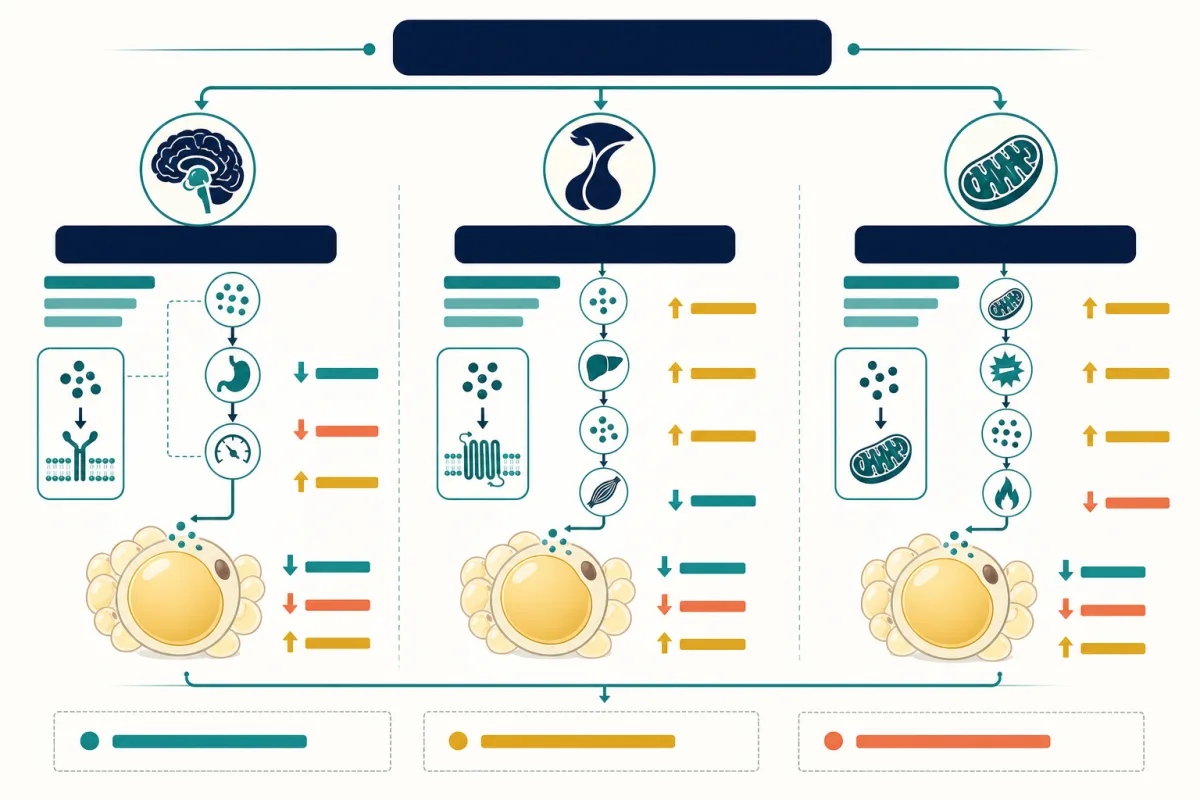
That framing is misleading, because the compounds most studied for fat-loss research do not share a mechanism — they fall into three distinct families, each acting on a different part of energy balance.
Organizing them by mechanism is far more useful than ranking them, because the right research compound depends entirely on which pathway a study is designed to interrogate.
The three families are: incretin agonists (appetite and glucose-handling pathways), growth-hormone secretagogues (lipolysis and body-composition pathways), and mitochondrial/metabolic compounds (cellular energy and substrate-use pathways). A fourth, the amylin analog cagrilintide, sits adjacent to the incretins and is increasingly studied in combination with them.
Why does the mechanism-first approach matter more here than in most peptide categories?
Because fat loss is not a single biological process — it is the net result of energy intake, energy expenditure, substrate partitioning, and hormonal signaling, and different compounds touch different parts of that equation.
Ranking them without naming the mechanism is like ranking tools without naming the job. A laboratory studying appetite regulation needs a different starting point than one studying lipolysis or mitochondrial substrate use, even if both are framed as "fat-loss research.
"
This guide walks each family, summarizes what the literature supports, and covers the documentation realities common to all of them. It is RUO education — not medical advice, dosing guidance, or a recommendation for personal use. For foundational context, see the weight-management research guide.
Family 1 — Incretin agonists (the appetite and glucose axis)
This is the most clinically validated family and the reason peptide fat-loss research exploded in visibility. Incretin agonists act on the GLP-1 receptor (and, in the multi-agonists, GIP and glucagon receptors) to influence appetite signaling, glucose-dependent insulin secretion, and gastric emptying.
- Semaglutide — single GLP-1 agonist; the most mature data set and the field's reference compound.
- Tirzepatide — dual GIP/GLP-1 agonist; larger effect signals than semaglutide in published comparisons.
- Retatrutide — triple GIP/GLP-1/glucagon agonist; the largest Phase II signals observed, with the thinnest long-term data.
- Cagrilintide — long-acting amylin analog; studied for appetite suppression and increasingly for synergy with GLP-1 agonism.
The incretin family is the right starting point for research centered on appetite regulation and glycemic mechanisms. A full mechanistic comparison of the three incretin agonists is available in our retatrutide vs tirzepatide vs semaglutide breakdown, and the GLP-1 research guide covers receptor pharmacology in depth.
Family 2 — GH secretagogues and lipolysis fragments
The second family works through the growth-hormone axis rather than the gut-hormone axis. The rationale is that growth hormone influences lipolysis (the breakdown of stored fat) and body composition, so compounds that stimulate endogenous GH release — or fragments derived from GH itself — are studied for fat-handling effects distinct from appetite suppression.
- Tesamorelin — a GHRH analog with the deepest clinical footprint here; notably studied for visceral adipose tissue reduction.
- CJC-1295 — a GHRH analog studied for sustained elevation of GH/IGF-1 signaling.
- Ipamorelin — a selective GH secretagogue noted in research for releasing GH with minimal cortisol or prolactin effect.
- HGH Fragment 176-191 — the isolated lipolytic domain of growth hormone, studied for fat metabolism with reduced effect on IGF-1.
- AOD-9604 — a modified fragment of GH studied specifically in metabolic and body-composition models.
This family suits research into lipolysis and growth-axis mechanisms, and the GH secretagogues are often modeled in combination (for example a GHRH analog with a selective secretagogue) to study pulsatile GH release. See the HGH Fragment 176-191 overview and the body-composition research guide.
Free Peptide Calculator
Calculate precise reconstitution volumes and dosages with our peptide calculator tool.
Family 3 — Mitochondrial and metabolic compounds
The third family is the most mechanistically novel and the least clinically mature. Rather than acting on appetite or the GH axis, these compounds are studied for effects on cellular energy production and substrate utilization — essentially how efficiently cells burn fuel.
- MOTS-c — a mitochondrial-derived peptide studied in metabolic-regulation and exercise-mimetic models, with interest in how it influences insulin sensitivity and energy homeostasis.
- SLU-PP-332 — an ERR (estrogen-related receptor) agonist studied as an "exercise mimetic," with preclinical interest in oxidative metabolism and endurance pathways.
This family is the right fit for research into cellular-level metabolism and mitochondrial function rather than systemic appetite or hormone signaling. The evidence base is predominantly preclinical, and these compounds are best understood as frontier research tools rather than established fat-loss agents. Both should be approached with conservative experimental design and rigorous documentation, given the limited data.
Get Peptide Research Updates
New research, product launches, and exclusive offers. No spam.
Comparing the families at a glance
The table organizes the families by the research question each best serves. "Evidence depth" reflects the general maturity of published data, not a guarantee of effect in any specific model.
| Family | Primary mechanism | Representative compounds | Evidence depth | Best research fit |
|---|---|---|---|---|
| Incretin agonists | Appetite + glucose handling | Semaglutide, tirzepatide, retatrutide, cagrilintide | Most mature | Appetite / glycemic mechanisms |
| GH secretagogues | Lipolysis + GH axis | Tesamorelin, CJC-1295, ipamorelin, HGH Frag 176-191, AOD-9604 | Moderate to deep | Lipolysis / body composition |
| Mitochondrial / metabolic | Cellular energy use | MOTS-c, SLU-PP-332 | Emerging / preclinical | Mitochondrial function |
The practical takeaway: there is no single "best" fat-loss peptide. The incretin family has the strongest evidence for appetite-driven research; the GH family for lipolysis-driven research; the mitochondrial family for cellular-metabolism research. A study should select the family whose mechanism matches its hypothesis.
Important Disclaimer
All products and information on this page are intended strictly for laboratory and scientific research use only. Not for human consumption. These statements have not been evaluated by the FDA.
Documentation and sourcing across all three families
One requirement is universal regardless of family: batch-specific documentation. Every compound above is sold for research use only, and conclusions drawn from uncharacterized material are unreliable by definition.
Before procurement, laboratories should confirm on a COA the identity (mass spectrometry), purity (HPLC, typically ≥98% with the chromatogram available), a batch number matching the vial, and the stated net peptide content.
Pricing varies widely across these compounds — from economical single-agonist and GH-secretagogue material to premium triple-agonist and novel metabolic compounds — so price-per-milligram comparison across vendors is more informative than list price.
Handling matters too; reconstituted material in every family degrades faster than lyophilized powder, so review the storage guide before planning experiments.
For the incretin family in particular, sequence length and modification state (for example acylation in semaglutide) affect synthesis complexity and the impurity profile a chromatogram should reveal — another reason the trace matters as much as the headline number.
PurePep Vital compares vendor documentation rather than selling product. Browse the full catalog on the weight-management research category, with live pricing and partner codes aggregated on the deals hub.
Live Alpha Labs is our top-rated tracked vendor for documentation transparency and credit-card checkout; PurePep readers can use code SOL for 10% off eligible research orders, with BluGen and Halo compared alongside.
Combination research and why pairing matters
Much of the most active 2026 fat-loss research examines combinations across families rather than single compounds, because the families act on non-overlapping pathways.
The most discussed example is the pairing of an incretin agonist with the amylin analog cagrilintide — engaging appetite regulation through two distinct receptor systems — which has drawn significant research attention for the magnitude of effects observed in trials of the corresponding formulations.
The growth-hormone family is also frequently modeled in combination: a GHRH analog such as CJC-1295 paired with a selective secretagogue such as ipamorelin is studied to investigate pulsatile GH release more completely than either alone. The logic mirrors the recovery-stack rationale — complementary mechanisms may approximate integrated physiology better than isolated ones.
Two cautions apply. Combination research compounds uncertainty: two uncharacterized inputs make documentation discipline more important, not less. And cross-family pairing (for example an incretin with a GH secretagogue) is far less studied than within-family pairing, so the evidence base thins quickly as combinations get more ambitious. Our overview of research peptide stacks covers how combination studies are structured.
Common pitfalls in fat-loss peptide research
Several recurring errors undermine fat-loss peptide research before mechanism is ever in question.
- Treating the families as interchangeable. An incretin agonist and a mitochondrial compound answer different questions. Choosing by popularity rather than mechanism produces uninterpretable results.
- Comparing list prices instead of price-per-milligram. Vial sizes and net peptide content vary widely; headline price is a poor proxy for value across compounds and vendors.
- Ignoring counterion and net content. Acetate versus trifluoroacetate forms and stated net peptide content change how much active material is actually present — a frequent source of dosing-math error in volume calculations.
- Over-reading preclinical data. The mitochondrial family is largely preclinical; treating exercise-mimetic findings as established fat-loss outcomes overstates the evidence.
- Skipping the chromatogram. A purity percentage without the underlying HPLC trace and a matching batch number is incomplete verification.
Avoiding these keeps fat-loss research interpretable and within research-use boundaries. The COA reading guide and storage guide address the documentation and handling pitfalls directly.
A selection framework for research programs
Rather than chasing a ranked list, match the compound family to the research question:
- Investigating appetite or glycemic pathways? Start with the incretin family — semaglutide as a reference, tirzepatide for greater potency with depth, retatrutide for frontier multi-receptor work.
- Investigating lipolysis or body composition via the GH axis? Consider tesamorelin (deepest clinical footprint), the GHRH-analog/secretagogue combinations, or the GH fragments for IGF-1-sparing lipolysis.
- Investigating cellular metabolism and mitochondrial function? MOTS-c and SLU-PP-332 are the frontier tools, with the caveat of predominantly preclinical evidence.
Across every family, the same discipline applies: anchor work to peer-reviewed endpoints, verify every batch against a real COA, compare price-per-milligram rather than list price, and keep all work within research-use boundaries. None of these compounds is an approved fat-loss therapy in research form, and nothing here is medical or dosing advice.
To continue, see the incretin deep-dive in retatrutide vs tirzepatide vs semaglutide, the weight-management research guide, or compare current offers on the deals hub. For reconstitution volumes, the peptide calculator handles the math without providing dosing recommendations.
Important Disclaimer — For Research Use Only
The information provided is for educational and research purposes only. All peptides discussed or linked on this site are intended strictly for laboratory and scientific research use only (RUO) and are not for human consumption, injection, ingestion, or any therapeutic application. These products have not been evaluated or approved by the FDA or any regulatory body and are not intended to diagnose, treat, cure, or prevent any disease or condition. Reliance on this content is at your own risk. Consult qualified professionals for any health-related decisions. PurePep Vital disclaims all liability for misuse. Products are offered by third-party retailers for research use only.
PurePep Vital is an editorial publisher, vendor comparison resource, and affiliate deal tracker. We do not manufacture, compound, sell, ship, test, prescribe, or handle peptide products. Purchases are completed directly through third-party retailers. PurePep Vital is not a compounding pharmacy or chemical compounding facility as defined under 503A of the Federal Food, Drug, and Cosmetic Act. PurePep Vital is not an outsourcing facility as defined under 503B of the Federal Food, Drug, and Cosmetic Act.
Disclosure: This page contains affiliate links. We may earn from qualifying purchases. See our full disclosure.
Need deals after the research?
Use the deals hub to compare current offers, partner codes, and research news. We recommend retailers that provide quality signals when available.
Explore Our Guides
Related Articles
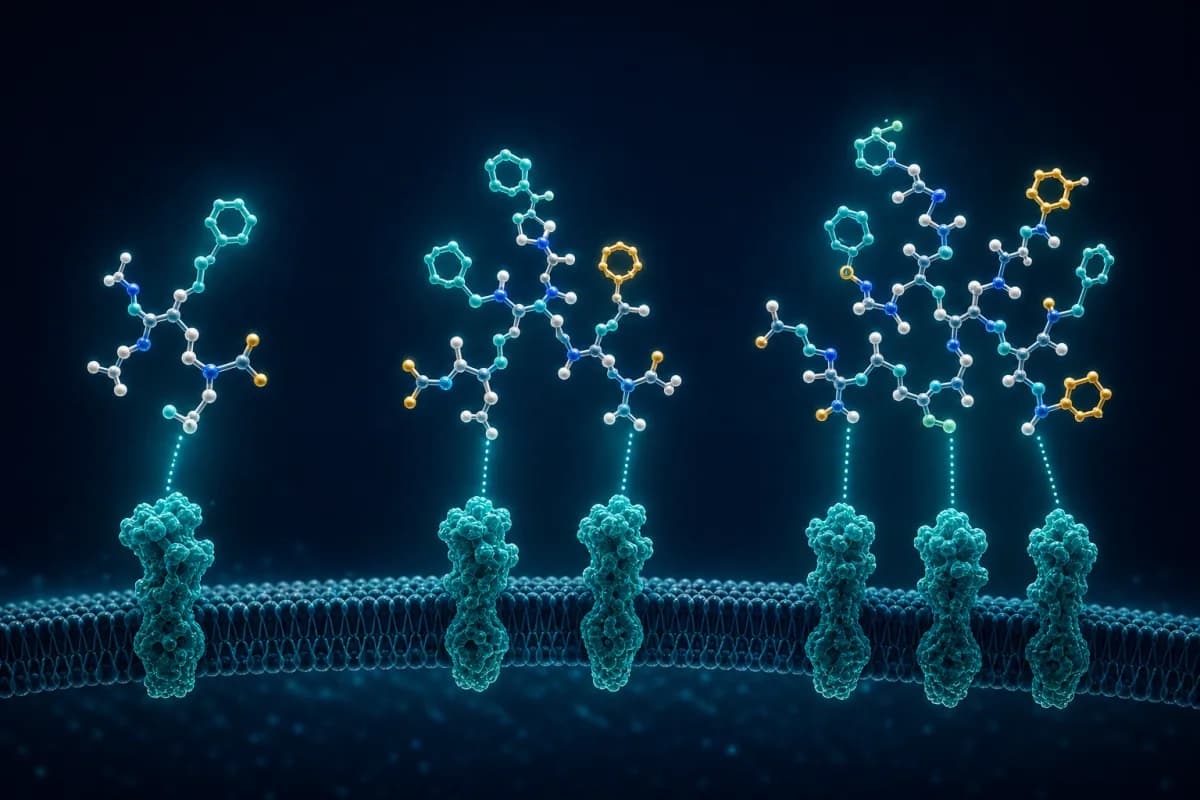
Retatrutide vs Tirzepatide vs Semaglutide: A 2026 Research Comparison
Semaglutide, tirzepatide, and retatrutide represent single, dual, and triple incretin receptor agonism. This guide compares their mechanisms and published research context so laboratories can choose the right compound for a study.

Tirzepatide Peptide: Dual-Action GLP-1 Research
Tirzepatide is the first dual GIP/GLP-1 receptor agonist, combining two incretin pathways for unprecedented metabolic effects. Here is what the clinical data reveals.

Peptide Stacks for Research: Combination Planning (RUO)
“Stacking” in legitimate research means orthogonal hypotheses with separated endpoints—not mixing maximal doses. Here is a disciplined framework plus literature routing.
BPC-157 and TB-500 Stack: What the Recovery Research Actually Shows
BPC-157 and TB-500 are the two most-paired peptides in tissue-repair research. This guide explains why their mechanisms are studied together, what the preclinical literature supports, and how laboratories evaluate documentation before sourcing.
Frequently Asked Questions
They fall into three mechanistic families: incretin agonists (semaglutide, tirzepatide, retatrutide, cagrilintide) for appetite and glucose pathways; GH secretagogues (tesamorelin, CJC-1295, ipamorelin, HGH Fragment 176-191, AOD-9604) for lipolysis; and mitochondrial compounds (MOTS-c, SLU-PP-332) for cellular metabolism. The right one depends on the research question.